
CEOxHR debate: Can participatory leadership paralyse decision-making?
Participatory leadership promises more involvement and buy-in. But does it also lead to more decisions, or rather to endless consultation and indecision?
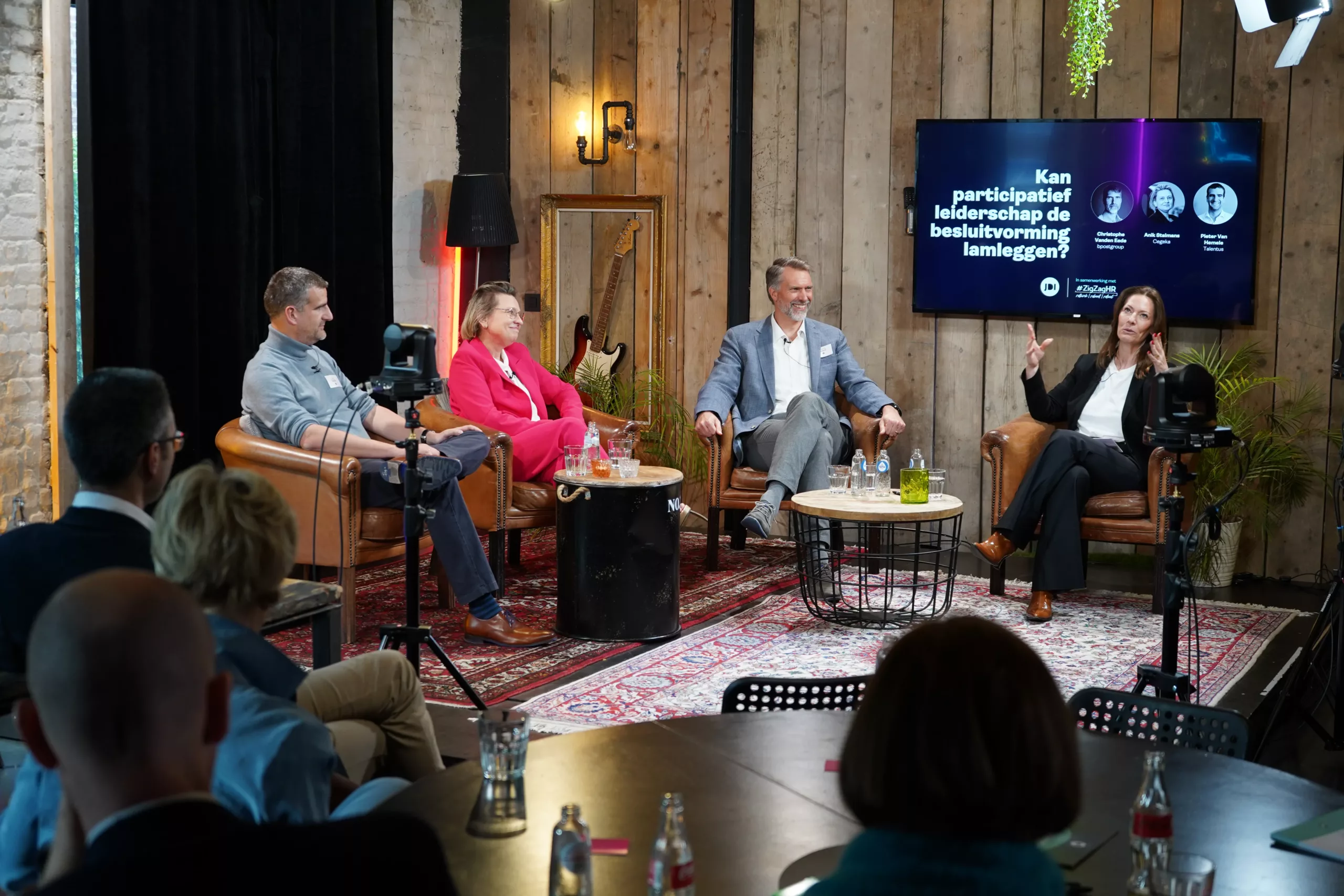
During the CEOxHR event we went straight for the sore spot. Together with Christophe Vanden Eede (bpostgroup), Anik Stalmans (Cegeka) and Pieter Van Hemele (Talentus), expertly moderated by Lesley Arens (#ZigZag HR), we dug into the nuances of participatory and shared leadership. When does it work, and how do you avoid a situation where everyone gets to chip in, but nobody makes the final call?
Participatory leadership in practice
Participatory leadership sounds great on paper, but the reality is… complicated. Christophe opened the conversation with a sharp observation: its success depends heavily on how mature your organisation is. Do you already have a culture where participation thrives, or are you hoping that culture will grow once you introduce participatory ways of working? A proper chicken-and-egg question.
On top of that, you need to be clear on this: where can employees truly make decisions, and where can they only give input? And by when will the decision be made? Without those boundaries, involvement quickly turns into frustration.
Leadership in uncertain times
But leading people is not simple these days either, of course! Economic uncertainty, wars, … Fear is the default emotion in many organisations. And that makes people look for direction, something to hold on to. Strong leadership, then.
But as a leader, you also need to be willing to make real choices. No endless compromises where everyone is ‘sort of happy’ and in the end nobody actually gets anything done. Pieter sums it up well: ‘Before long you’ve compromised so much that nothing of substance is left.’
Participation at scale: ambition vs. feasibility
So how do you scale participation when your organisation has thousands of employees? Christophe gave a concrete example: the forward-looking programme for 16,000 postal workers at bpost. You can’t run that with a decision-making group of five. At that scale, you really need to listen, gather feedback and take signals seriously.
But participation only works if you first have internal buy-in, Pieter says. If your Steerco is already divided, will you ever get the rest of the organisation on board? That takes maturity from both sides: from the leaders and from the employees who are allowed to help make the decisions.
Participatory vs. shared leadership: what’s the difference?
Let’s get the terms straight. Anik explained the difference: participatory leadership means asking for input but making the decision yourself. Shared leadership means handing over mandates, delegating responsibility, extending trust and letting go.
Christophe added a reality check. Expectations of managers are now so broad that shared leadership is almost essential. No leader can carry everything alone any more. But be careful: not every organisation, task or person is ready for that level of autonomy. Context still matters most.
Conflict is part of participation
We close with a surprising theme that may well sit at the heart of participation: conflict. We often see it as something negative, something we would rather avoid. But in reality, conflict is exactly the fuel for growth… when it is handled well!
A difference of opinion, voiced with respect, shows commitment and conviction. That is exactly what makes teams strong.
Conclusion: participation is a balancing act
So, does participatory leadership paralyse decision-making?
The short answer: sometimes, yes, when it happens without a framework, maturity and a mandate. When everyone is invited to weigh in but nobody knows who makes the final call, you get delay and frustration.
But the longer answer is: not if you get it right. It works when you genuinely involve people, make clear what their role in the process is, and then have the nerve to make the final call.
It takes courage from leaders and maturity from employees, but above all a tightly organised decision-making process. Then participation leads to better decisions and broader buy-in, without things grinding to a halt.
More insights

8 signs your team is not speaking up about problems, or is doing it too late, plus what you can do about each one.

At the CEOxHR event we explored whether agile leadership leads to impact or to confusion. And what part context, clarity and self-awareness play.

During the CEOxHR event, we explored how leaders grow: training is the starting point, follow-up and coaching do the rest. A case for leadership as a process, not a certificate.
Want to take this on in your business?
You don’t have to have your question sorted yet. Working that out is exactly where we start.