
Digital marketing agency or full-service agency: what do you need?
You’re looking for an online marketing agency, because your customers search for you online anyway.
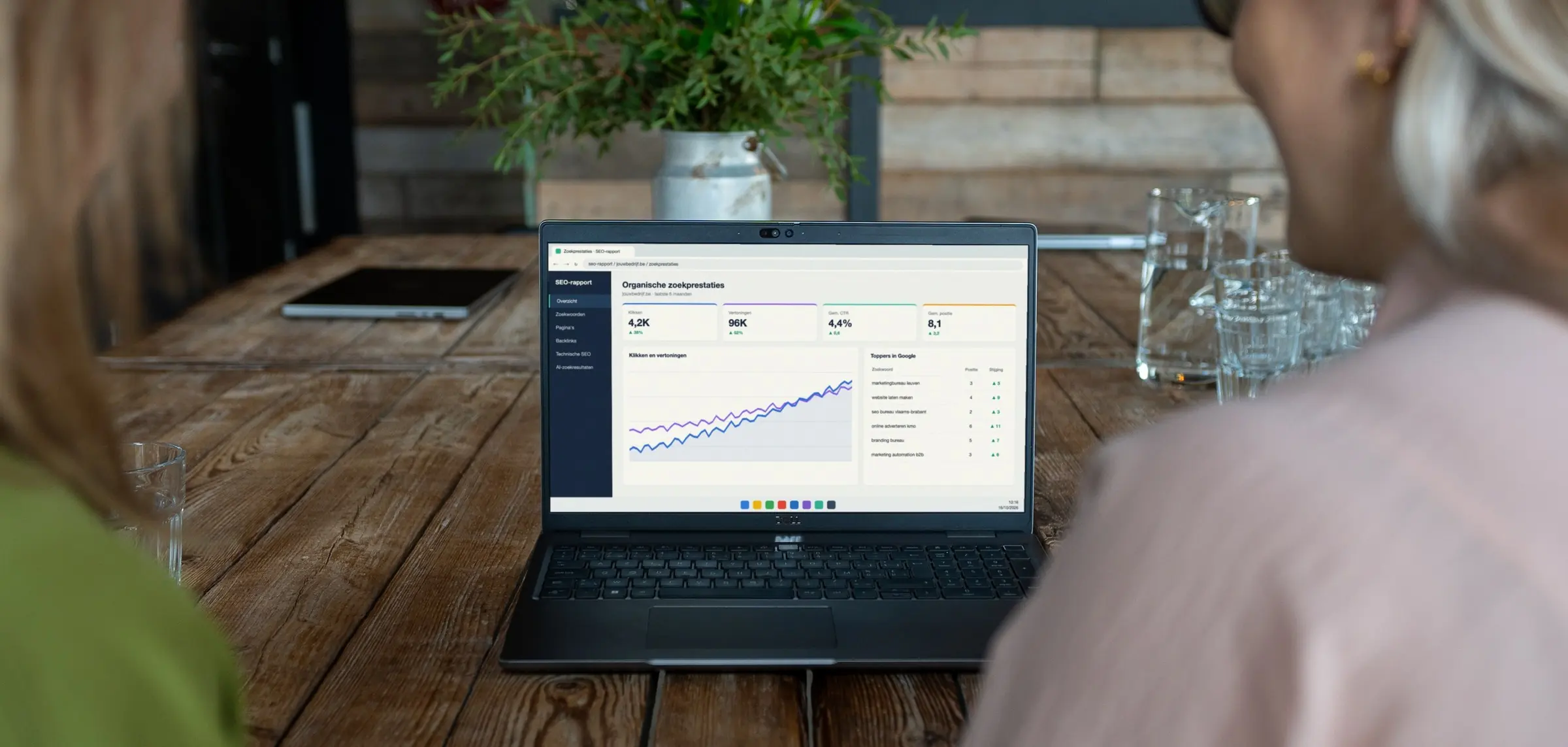
But your salespeople still drive out to visit customers, you exhibit at a trade fair twice a year and your quote has looked the same for ten years. So do you need a digital agency that takes care of your website and Google, or a full-service agency that does everything? The answer depends on how your customers buy, and on what you already have in-house.
In short: A digital or online marketing agency does everything that happens online: website, SEO, Google Ads, social media, email and analytics. A full-service marketing agency does that too, but starts with your strategy and your brand, and also covers offline work such as trade fairs, print, video and events. If you mainly sell online, or your strategy is already set, a digital agency is enough. If you sell through people, conversations and trade fairs, like most B2B SMEs, you’ll get more from a full-service agency that brings online and offline into line.
What does a digital marketing agency do?
A digital marketing agency, also called an online marketing agency, focuses on everything that happens online. It builds and improves your website, makes sure you are found in Google, sets up ads and manages your social media. Often it also handles email marketing and the analysis of your figures: how many visitors, where they come from and how many send an enquiry. The strength of a good digital agency lies in measuring and adjusting. An ad that delivers nothing gets changed after a week.
- Website: building, maintaining and improving it, so visitors turn into enquiries. More about having a website built.
- SEO and GEO: being found in Google, and being mentioned in answers from ChatGPT and Google AI Overviews. More about our approach to SEO and GEO.
- Online advertising: Google Ads, LinkedIn, Meta. Quick results as long as you pay. More about online advertising.
- Social media and email: regular contact with your customers and prospects.
- Analytics: what works, what doesn’t, and where the budget delivers the most.
What does a full-service marketing agency do?
A full-service marketing agency does all of the above, but starts one step earlier. Before there is a website or an ad, it looks at your strategy: who your customers are, why they choose you and what you tell them. Then it works on your brand: positioning, visual identity, the way you speak. It also takes on the work that does not happen online: trade fair material, brochures, a company film, a customer event, your salespeople’s presentation. That way everything your customer sees of you tells the same story, online and offline. You can read how it differs from an advertising or communications agency in Marketing agency, advertising agency or communications agency.
The difference in one table
| Digital marketing agency | Full-service marketing agency | |
|---|---|---|
| Starts with | Your website and your online channels | Your strategy, your customer and your brand |
| Services | Website, SEO, Google Ads, social media, email, analytics | Everything digital + strategy, branding, video, print, trade fairs, events |
| Strong in | Measuring and adjusting quickly, technical knowledge | One story across all channels, one point of contact |
| Less strong in | Strategy and everything that happens offline | Sometimes less depth in a single specialism |
| Suits | Webshops, companies that sell online, companies with their own marketer and a clear strategy | SMEs without their own marketing department, B2B companies that sell through people and trade fairs |
Why “digital” alone often isn’t enough for an SME
Most buyers today search online first. They google, compare websites, ask ChatGPT for advice and read reviews. But for many SMEs, especially in B2B, the decision isn’t made online. It’s made after a conversation with a salesperson, a visit to a trade fair stand or a quote that’s well put together. If your website says something different from your salesperson, or your trade fair stand looks different from your LinkedIn, the customer drops out without you knowing why.
That’s why an SME often gets more from an agency that knows both worlds. Not because online is less important, but because online and offline need to reinforce each other. Your website brings in the enquiry, your salesperson closes the deal, and both tell the same story. At JDI we call that: everything in line.
When a digital agency is the best choice
There are situations in which a specialist digital agency is the better choice. If you have a webshop and your sales happen entirely online, you want an agency that’s deep into ads, conversion and analytics. If you have your own marketer who looks after the strategy and the brand, a digital agency can add exactly the online expertise that’s missing. And if your strategy is clear and your brand strong, but you’re getting too little out of online, you don’t need a new story, you need more reach.
Five questions to help you choose
- How do your customers buy? Online with a click, or after conversations, quotes and visits?
- Is your strategy set? Do you know who your customer is and why they choose you, or is that exactly the question?
- Who looks after your brand? Is there someone internally who makes sure everything tells the same story?
- What do you do offline? Trade fairs, print, events, a sales team that needs materials?
- How many suppliers do you want? One point of contact, or are you prepared to coordinate several agencies?
If you answer most questions with “online”, “yes, set” and “we have a marketer”, a digital agency is enough. If you more often answer “through people”, “that’s exactly the question” and “one point of contact, please”, a full-service agency is a better match.
Note: “full-service” isn’t a protected term
Any agency can call itself full-service. Some have all the specialists in-house, others work with a network of freelancers and partners. That doesn’t have to be a problem. An agency that works with a specialist studio for video can deliver better videos than an agency that “just does it on the side” itself. What matters is that you have one point of contact who safeguards the quality and that you know who does what. Simply ask: which parts do you do yourselves, and who do you work with?
Online and offline in line: two examples
You can best see what that looks like in practice from real projects:
- Widem Logistics was mainly looking for online growth. We built a new website, did the SEO in four languages and set up ads in seven countries. From a few leads a year to 30 to 35 a month: a digital programme, with a clear positioning as its foundation.
- Think NXT, the annual ICT event of Proximus NXT, asked for the opposite. Together with Event Masters, we developed the creative concept and translated it into email invitations, web pages, partner packages and ads, and on site into keynotes, screen content and digital signage. During the show we took charge of directing it. Online and offline, one story for an audience of a thousand people.
How JDI approaches it
JDI is a full-service marketing agency in Neerijse, ten minutes from Leuven, for SMEs, family businesses and scale-ups. Our core is strategy, branding and concept: we start with your customer and your story, and come up with an idea you recognise everywhere. Then we carry it out, online and offline: website, SEO and GEO, ads, social media, print and events. Every project is tailored, with attention to quality down to the details: you won’t find production-line work with us. We shoot video and photos in our own studio, the JDI Studio, so your images tell the same story too. With Marketing as a Service you have one dedicated marketer who keeps the overview, so everything stays in line. Read more about our approach on our page as a marketing agency in Leuven. What a marketing agency actually does is explained in What does a marketing agency do for an SME?.
Frequently asked questions
What is an online marketing agency?
An agency that focuses on marketing through online channels: your website, Google (SEO and ads), social media, email and the analysis of what that delivers. It’s also called a digital marketing agency. In practice, the names mean the same thing.
Is a digital marketing agency cheaper than a full-service agency?
Per assignment sometimes, because it has fewer disciplines in-house. But if you also need a trade fair stand, print or a corporate film besides online, you’ll have to find those separately. Then you pay several agencies and you’re the one aligning everything. So compare the total, not the price per agency.
Can I start with online marketing and expand later?
Yes, and for many SMEs that’s a logical order. The website and your visibility in Google are often the foundation everything else rests on. But do choose an agency that can grow with you later, so you don’t have to start again after a year with another agency that still has to get to know your business.
Does a full-service agency really do everything itself?
Not always. “Full-service” isn’t a protected term. Some agencies have all the specialists in-house, others work with a network of freelancers and partners. That doesn’t have to be a problem, as long as you have one point of contact who safeguards the quality. Simply ask who does what.
As a B2B company, do I need a digital or a full-service agency?
Usually an agency that can do both. B2B customers search online for suppliers, but often only buy after a conversation, a trade fair visit or a quote. Your website, your LinkedIn, your sales reps and your trade fair stand then need to tell the same story. That works best when one partner keeps the overview.
Bring online and offline into line.
Unsure whether you need a digital or a full-service agency? Tell us how your customers buy and what you already do today, and we’ll tell you honestly what you need, even if that’s a specialist digital agency. You don’t need to have your question sharply defined yet. Working that out is exactly where we start. Email hallo@jdi.be or call 016 88 37 55. Plan an introductory meeting
More insights

What does a DISC test measure, what doesn’t it, and what do you gain with your team? Five steps, a comparison with Insights and MBTI and a short exercise.

What is peer supervision, how does it differ from supervision and coaching, and how do you run a session? Six steps, an example and eight good questions.

A summary of Vlerick’s Six Batteries of Change: the six batteries, how to scan them with your management team and how it differs from Kotter and ADKAR.
Want to take this on in your business?
You don’t have to have your question sorted yet. Working that out is exactly where we start.