
The DISC test: what does it measure and what do you get out of it?
You get an email from HR: ‘Could you complete the DISC test this week?’ A quarter of an hour later you have a report with four bars and a few pages of text about yourself.
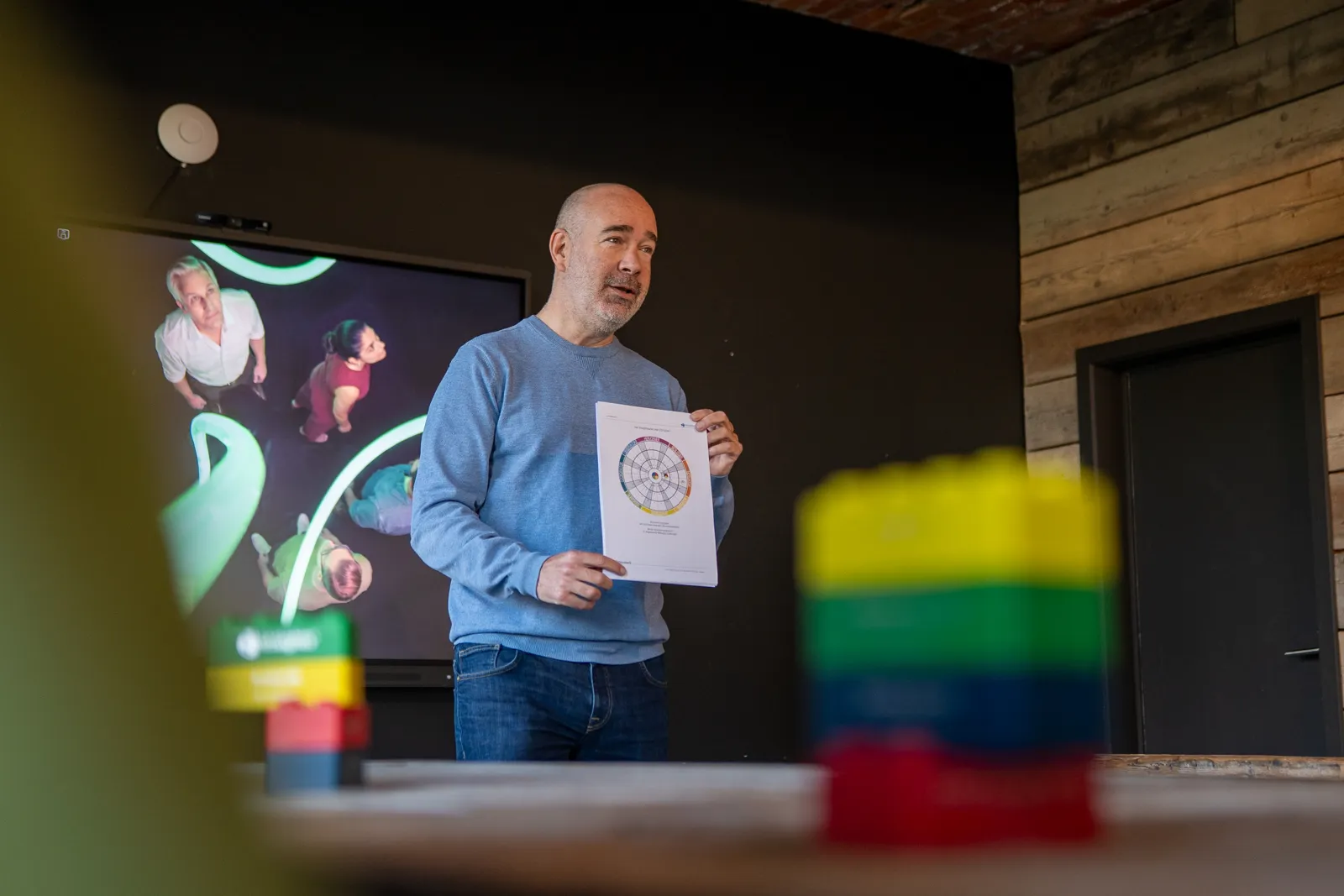
Some sentences are surprisingly accurate. But what do you do with it now?
In this blog you read what a DISC test measures, why the report only pays off with a conversation afterwards and how to get more out of it with your team. With a comparison with Insights Discovery and MBTI, the criticism and a short exercise.
In short: A DISC test is a questionnaire that describes your behaviour at work using four styles: Dominance, Influence, Steadiness and Conscientiousness. It measures preferred behaviour, not intelligence or suitability for a job. There are many versions of varying quality. What you get out of it depends mainly on the discussion afterwards: only when you put profiles side by side do you see where a team clashes and what you can do differently.
What is a DISC test?
A DISC test is a questionnaire that describes your behaviour using four styles: Dominance, Influence, Steadiness and Conscientiousness. The theory comes from the American psychologist William Moulton Marston, who described in the 1920s how ordinary people show their emotions in their behaviour. Marston didn’t create a test himself. Other authors and publishers later built questionnaires on his model, and that is why there are dozens of DISC tests side by side today.
What each style means and how to work with it, you read in our explanation of the four DISC styles. This blog is about the test itself: what happens when you complete it, what is in your report and how to do something with it as a team. The four profiles in detail, including the combinations, you will find in The four DISC profiles explained.
What a DISC test measures, and what it doesn’t
Most DISC tests work with small groups of statements. Each time, you choose which statement fits you most and which least. Precisely because all the statements are a little bit true, your preference comes to the surface. The result is a chart with four bars or points, with a description of how you communicate, decide and react under pressure.
- What it measures: your preferred behaviour in a particular context, usually your work. How quickly you decide, how directly you communicate, how much structure you need.
- What it doesn’t measure: intelligence, talent, values or how well you do your job. Two people with the same profile can perform very differently.
- What it sometimes also shows: the difference between your natural style and the style you adopt at work. A big difference costs energy, and that is often the most interesting part of the report.
Why a DISC test only pays off with a conversation afterwards
Reading a report doesn’t take long. You recognise a few sentences, smile at your pitfalls and close the laptop. The insight only comes when you put your profile next to your colleagues’ and discuss what that means for how you work together.
For the team
In a team, DISC makes visible why the same meeting goes too slowly for one person and too fast for another. The colleague with a lot of D wants to decide, the colleague with a lot of C wants the figures first, and the colleague with a lot of S says nothing because the atmosphere is already tense. With a shared language you can name that without anyone feeling attacked. ‘I notice I’m slipping into my D’ is easier to say than ‘sorry I was so blunt’.
For you
For you, a DISC test is a mirror. You see which style you use naturally and which you prefer to avoid. That helps in conversations with people who work differently: a customer with a lot of C expects a well-supported quote, a colleague with a lot of I wants to catch up first. As a result, you choose more consciously how to respond.
How to get more out of a DISC test, in five steps
1. Decide why you are doing the test
Do you want a team to clash less, a new manager to get to know his people, or salespeople to read customers better? The goal determines which report you need and how you build the discussion.
2. Choose one version for everyone
Don’t let every colleague take a different free test. The results then can’t be compared, and the discussion is about the test instead of about working together.
3. Answer from your work
For each question, think of an ordinary working day, not of how you are at home or how you would like to be. Go with your first instinct and choose a quiet moment.
4. Read your profile with a pen in your hand
Look first at your highest and your lowest style. Mark what is accurate and above all what surprises you. Where you don’t recognise yourself, the best conversation often lies.
5. Discuss it together and make agreements
Put the team’s profiles side by side and look for where there is friction. End with two or three concrete agreements, for example about how you make decisions or give feedback.
An example from a Belgian company
A fictional example. An accountancy firm in Ghent with fourteen employees has everyone complete the same DISC test. The partner has a lot of D, most of the case managers have a lot of C and S. In the discussion the penny drops: they read his short emails at half past seven in the evening as impatience, while he just wants to clear his head. The agreement is simple. He schedules his emails for the next morning and adds one sentence of context.
DISC test, Insights Discovery and MBTI side by side
If you are considering a DISC test, you often compare it with Insights Discovery and MBTI. They look alike, but you get something different. You can read an extensive comparison in Insights Discovery, DISC or MBTI.
| DISC test | Insights Discovery | MBTI | |
|---|---|---|---|
| Origin | Marston, behaviour and emotions | Carl Jung, translated into colours | Carl Jung, developed by Briggs and Myers |
| Result | Mix of four styles D, I, S and C | Mix of four colours, extensive profile | One of sixteen types |
| Versions | Many publishers, quality varies | One fixed questionnaire and profile | Official version via certified practitioners |
| Looks at | Visible behaviour | Behaviour and how you adapt | Preferences in thinking and energy |
| Strong at | Quick to explain, sales and customer contact | Shared language in a team | Depth about one person |
| Watch out | Don’t compare different versions | Works best with guidance | A team struggles to remember sixteen types |
Criticism of the DISC test
DISC is popular because it is simple, and that is also the source of most of the criticism.
- Many versions, varying quality. Because the model has no owner, anyone can make a DISC test. Some have been thoroughly tested, others are a handful of questions with a nice chart.
- Four styles are a simplification. People are more complex. If you use the profile as a label, you miss the nuance.
- Behaviour, not motives. DISC shows what you do, not why. Two colleagues with a lot of D can decide quickly for very different reasons.
- Socially desirable answers. Someone who takes the test because the boss asks them to sometimes chooses the answer that looks good.
Exercise: predict your own profile
Do this five-minute exercise before you complete a DISC test, or if you don’t want to do one yet. Answer each question with a number from 1 to 5. That way you take a conscious look at your own behaviour.
- How quickly do I make a decision when not all the information is there?
- How easily do I approach someone I don’t know yet?
- How much do I like to stick to a schedule that works?
- How often do I reread an email before I click send?
A high score on the first question points more towards D, on the second towards I, on the third towards S and on the fourth towards C. Then ask a colleague to answer the same questions about you. Where your scores are far apart, you have your first topic of conversation.
How JDI works with this
JDI guides teams with Insights Discovery. Like DISC, that model works with four styles, here four colour energies: Fiery Red, Sunshine Yellow, Earth Green and Cool Blue. It builds on the work of Carl Jung, and each team member gets an extensive profile. How the two models relate, you read in the comparison of Insights Discovery and DISC. The questionnaire is followed by a half-day in-company workshop, with exercises from your own practice. For managers, we link the profile to programmes with peer supervision and coaching. Read more about the questionnaire in our blog about the Insights Discovery test, and what we do in a workshop on our Insights Discovery page.
Frequently asked questions
What is a DISC test?
A DISC test is a questionnaire that measures how you behave at work, divided across four styles: Dominance, Influence, Steadiness and Conscientiousness. Each time, you choose which statements fit you best and least. The result is a profile that shows how strongly each style is present in you. See it as a weather forecast of your behaviour: it says what you usually do, not what you will always do.
How does DISC work?
DISC classifies behaviour along two questions: are you more fast and outspoken or calm and reserved, and do you focus more on the task or on the people? Those combinations produce four styles. Everyone has all four, in their own mix. Your profile shows which styles you use most often and which you find harder to use.
What does a DISC test cost?
That depends on the version and what you get with it. A short online test is often free, an extensive report from a publisher costs more, and a debrief with a practitioner or a team workshop comes on top of that. So don’t just compare the price of the questionnaire. A cheap test that nobody discusses turns out to be the most expensive: you pay for a report in a drawer.
Is a free DISC test reliable?
As a first introduction, yes; as a basis for decisions, no. Free tests vary widely in quality, and two free tests can give you a different profile. Use such a test to get to know the model and to look at your own behaviour from a different angle. If you want to work with it as a team, choose one well-founded version for everyone.
Can you use a DISC test in recruitment?
Be careful with it. DISC describes behavioural preferences, not skills or suitability for a job. Someone with little D can be a perfectly good manager, he just does it in a different way. If you use a DISC test in selection, you run the risk of missing good candidates. Rather use it after recruitment, to help a new colleague fit into the team faster.
What is the difference between DISC and Insights Discovery?
Both work with four styles that roughly correspond: D with Fiery Red, I with Sunshine Yellow, S with Earth Green and C with Cool Blue. DISC goes back to William Moulton Marston and exists in many versions, Insights Discovery builds on Carl Jung and works with one fixed questionnaire. One model is not better than the other, but colours often stick in a team more easily than letters.
Make the differences in your team discussable.
Want to know how you and your team communicate, and where there is friction? With an Insights Discovery profile and a half-day or full-day workshop, we make the differences visible and discussable. Email hallo@jdi.be or call 016 88 37 55. Get to know your team with Insights
More insights

What is peer supervision, how does it differ from supervision and coaching, and how do you run a session? Six steps, an example and eight good questions.

A summary of Vlerick’s Six Batteries of Change: the six batteries, how to scan them with your management team and how it differs from Kotter and ADKAR.

What is Prosci’s CLARC model? The five roles of the manager during change, applied in five steps and set alongside ADKAR.
Want to take this on in your business?
You don’t have to have your question sorted yet. Working that out is exactly where we start.