
The Insights colours explained: red, yellow, green and blue
Every meeting has someone who wants to decide straight away, someone who wants to see all the figures first, someone who asks how the team feels about it and someone who already has three new ideas.
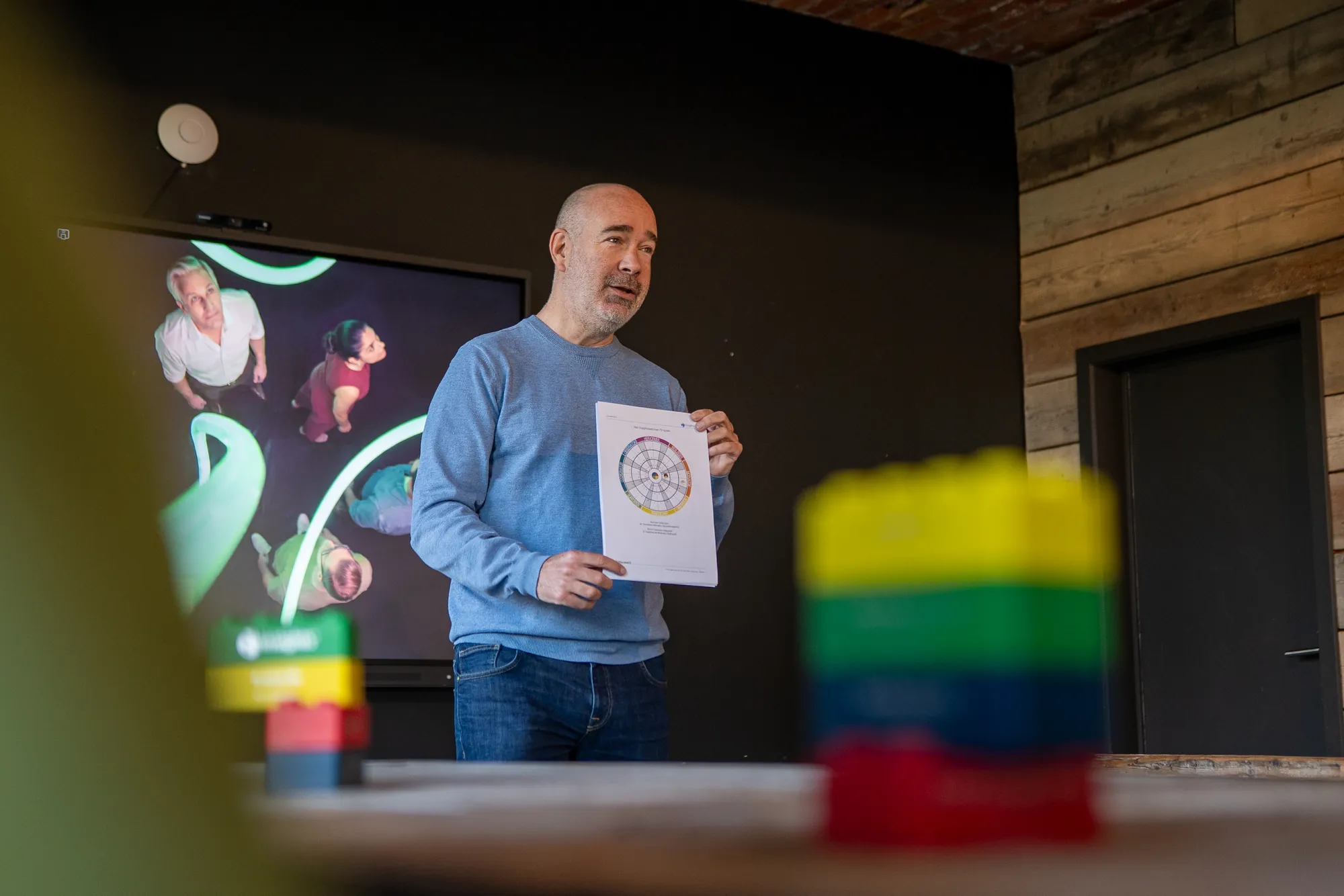
Sound familiar? Then you’ve already seen the four Insights colours at work. In this blog you’ll read what red, yellow, green and blue mean, where they come from and what you can do with them in a team. And also what the colours are not, because that’s often where things go wrong.
In short: The Insights colours come from Insights Discovery, a model that describes behavioural preferences using four colour energies. Fiery Red stands for drive and results, Sunshine Yellow for enthusiasm and connection, Earth Green for care and harmony, and Cool Blue for analysis and precision. Everyone has all four colours, in their own mix. No colour is better than another: the model helps you know your own preference and learn to read other people’s, so you work together better.
Where the four colours come from
The Insights Discovery model builds on the work of the Swiss psychiatrist Carl Jung. Jung described how people differ in where they get their energy and how they make decisions. Do you get your energy from the outside world and from contact with others, or rather from your own thoughts? Do you decide mainly on the basis of logic and facts, or on the basis of values and the effect on people?
Those two questions produce four combinations, and Insights gave each one a colour. If you’re extraverted and decide based on logic, you have a red preference. Extraverted and led by feeling: yellow. Introverted and led by feeling: green. Introverted and led by logic: blue. Colours are simply easier to remember than psychological terms, and that’s exactly the point: a language everyone in a team understands straight away.
| Colour | Energy and decisions | Typical behaviour | Needs | Pitfall |
|---|---|---|---|---|
| Fiery Red | Extraverted, logic | Direct, fast, results-driven, takes charge | Clear goals and pace | Impatient, rides roughshod over others |
| Sunshine Yellow | Extraverted, feeling | Enthusiastic, sociable, full of ideas, persuasive | Freedom, contact and recognition | Promises a lot, finishes less |
| Earth Green | Introverted, feeling | Caring, patient, loyal, a good listener | Calm, trust and time | Avoids conflict, doesn’t say what they think |
| Cool Blue | Introverted, logic | Analytical, precise, structured, critical | Information, time and clarity | Keeps analysing, can seem distant |
Cool Blue: the one who wants to understand everything first
Someone with a lot of blue wants to know the facts before giving an opinion. They read the attachment before the meeting, ask the question nobody had thought of yet and would rather have a good decision next week than a quick one today. At its best, blue ensures quality and prevents costly mistakes. Under pressure, blue can disappear into details, or come across as critical when they simply want to understand how things are.
Working with a blue colleague? Send your question in advance, with the figures attached. Give them time to think, and don’t expect an enthusiastic response to an idea that hasn’t been worked out yet.
Earth Green: the one who thinks about people first
Green is the colleague everyone turns to. They listen, notice when someone isn’t feeling themselves and want a decision to have everyone’s support. Green is loyal and reliable, and holds a team together when things get tough. The risk is that green stays quiet for too long. They avoid conflict, say “yes” while thinking “no”, and feel overwhelmed by change that comes too fast.
Working with a green colleague? Ask explicitly for their opinion, preferably one to one. Explain why something is changing and what it means for people, and give them time to get used to it.
Sunshine Yellow: the one who lights the spark
Yellow brings energy into the room. They have ideas, can win people over and see opportunities everywhere. A brainstorm with plenty of yellow produces ten ideas in fifteen minutes. Yellow likes working with others, talks easily and has a large network. The flip side: yellow starts a lot and doesn’t finish everything. Details and planning feel like a brake, and a yellow colleague can be more optimistic about a deadline than reality allows.
Working with a yellow colleague? Give room for ideas, but agree together on what will actually happen and by when. Recognition works better with yellow than a list of comments.
Fiery Red: the one who wants it done
Red wants to move forward. They make decisions, set the direction and say what they think. In a crisis red is worth its weight in gold: someone has to make the tough calls. Red loves a challenge and has little patience for long meetings without a conclusion. Under pressure red can come across as blunt. They listen less, decide alone and forget that others need time to get on board.
Working with a red colleague? Get straight to the point, start with the conclusion and say what you need from them. A short email with three bullet points works better than a long story.
Everyone has all four colours
The biggest misunderstanding about the Insights colours is that you are one colour. That’s not true. Everyone has all four colours, just in different proportions. Most people have one or two colours that are strongly present, and one colour they use least. That’s why Insights Discovery also distinguishes eight main types and, within those, 72 positions on a wheel. So your profile is much more precise than “I’m red”.
On top of that, you don’t behave the same way everywhere. At home you might be more yellow than at work, or you may have learnt to be more blue at the office because your role demands it. The profile also shows that difference, and how much energy it costs you to adapt. People who behave differently from their preference for years often get tired from it without knowing why.
How to recognise the colours in your colleagues
You don’t need to take a test to recognise the colours in others. A few clues already help:
- Pace: red and yellow speak and decide quickly, green and blue take more time.
- Focus: red and blue talk about the task, yellow and green about the people.
- Emails: red writes briefly, yellow with exclamation marks, green starts by asking how you are, blue sends a structured attachment.
- Meetings: red wants a decision, yellow a brainstorm, green a consensus, blue a well-prepared proposal.
- Under pressure: red becomes dominant, yellow chaotic, green stubborn or silent, blue critical and distant.
One caveat: you see behaviour, not preference. Someone can come across as very blue at work because their role demands it. So use the colours as a starting point for a conversation. How the colours change under stress is explained in Insights colours on a bad day.
What the colours mean for a team
In a team the colours really become interesting. A team with a lot of red and yellow decides quickly and is full of energy, but sometimes forgets the details and the people who aren’t on board. A team with a lot of blue and green is thorough and loyal, but is slow to get moving and avoids difficult conversations. Neither is bad. It does help to know which colour your team is missing, so you can consciously make room for it.
Most friction lies between opposite colours: red versus green, yellow versus blue. The red manager who thinks their green employee is too slow. The blue controller who gets annoyed with the yellow sales manager who never fills in a report. Often the conflict isn’t about content, but about style. Once you see that, you can resolve it. How to communicate with each colour is explained in Communicating with the four colours.
What the Insights colours are not
- Not boxes. The colours describe a preference, not a fixed trait. Anyone who says “I’m just red, so I’m direct” is using the model as an excuse.
- Not a ranking. No colour is better or smarter. Every colour has strengths and pitfalls.
- Not a selection tool. JDI uses the colours to work together better, not to decide who gets a job.
- Not an end point. The profile is the start of a conversation. The real value lies in what a team does with it.
Knowing your own colours, and your team’s
You discover your own colour mix with the official Insights Discovery questionnaire. It takes about twenty minutes and produces an extensive personal profile, with your strengths, pitfalls and how you come across to others. How the test works is explained in The Insights Discovery test.
JDI runs Insights Discovery programmes for teams at SMEs, family businesses and scale-ups: a short conversation beforehand, the questionnaire, a personal profile and a team workshop with concrete agreements. At Buildwise more than 300 employees went through the same workshop day, from senior management to office workers. At Crelan Group we formed one audit team out of two banks, with more trust thanks to a shared language. Read more about our approach on the Insights Discovery page.
Frequently asked questions
Which Insights colour am I?
You only know for sure after the official questionnaire, which takes about twenty minutes. You can make a first guess, though: if you think first and only then speak, you’re more likely blue or green. If you talk in order to think, more likely red or yellow. But most people recognise themselves in two colours, and the profile shows exactly how strongly each colour is present in you.
Which Insights colour is the best?
None of them. Every colour has strengths and pitfalls, and a team needs them all. A team with only red decides quickly and clashes often. A team with only blue makes few mistakes, but is slow to get moving. So look mainly at which colour your team is missing.
Can your Insights colour change?
Your preference usually stays fairly stable, but your behaviour adapts. A red manager who works with a green team for ten years learns to listen patiently. Their preference stays red, their behaviour becomes broader. That’s why the profile also looks at how you adapt to your environment, and how much energy that costs.
What are the opposite Insights colours?
Red and green are opposites, as are yellow and blue. Red wants quick results, green wants everyone on board. Yellow wants new ideas, blue wants the facts first. Opposite colours clash fastest, but also complement each other best, provided they learn to speak each other’s language.
What is the difference between the four colours and the 72 types?
The four colours are the foundation. Because everyone has their own mix, Insights Discovery distinguishes eight main types and, within those, 72 positions on a wheel. Those positions make your profile much more precise than “you’re yellow”. In a team you usually use the colours, because everyone remembers them straight away.
Discover your team’s colours.
Want to know which colours are present in your team, and where that causes friction or makes things run smoothly? Tell us briefly about your team and what you want to achieve, and we’ll propose a tailored workshop. Email hallo@jdi.be or call 016 88 37 55. Discover your team’s colours
More insights

What does a DISC test measure, what doesn’t it, and what do you gain with your team? Five steps, a comparison with Insights and MBTI and a short exercise.

What is peer supervision, how does it differ from supervision and coaching, and how do you run a session? Six steps, an example and eight good questions.

A summary of Vlerick’s Six Batteries of Change: the six batteries, how to scan them with your management team and how it differs from Kotter and ADKAR.
Want to take this on in your business?
You don’t have to have your question sorted yet. Working that out is exactly where we start.