
The DISC model explained: the four behavioural styles and what to do with them
Your colleague responds to a proposal with “Let’s do it!”, while you still want to see the figures.
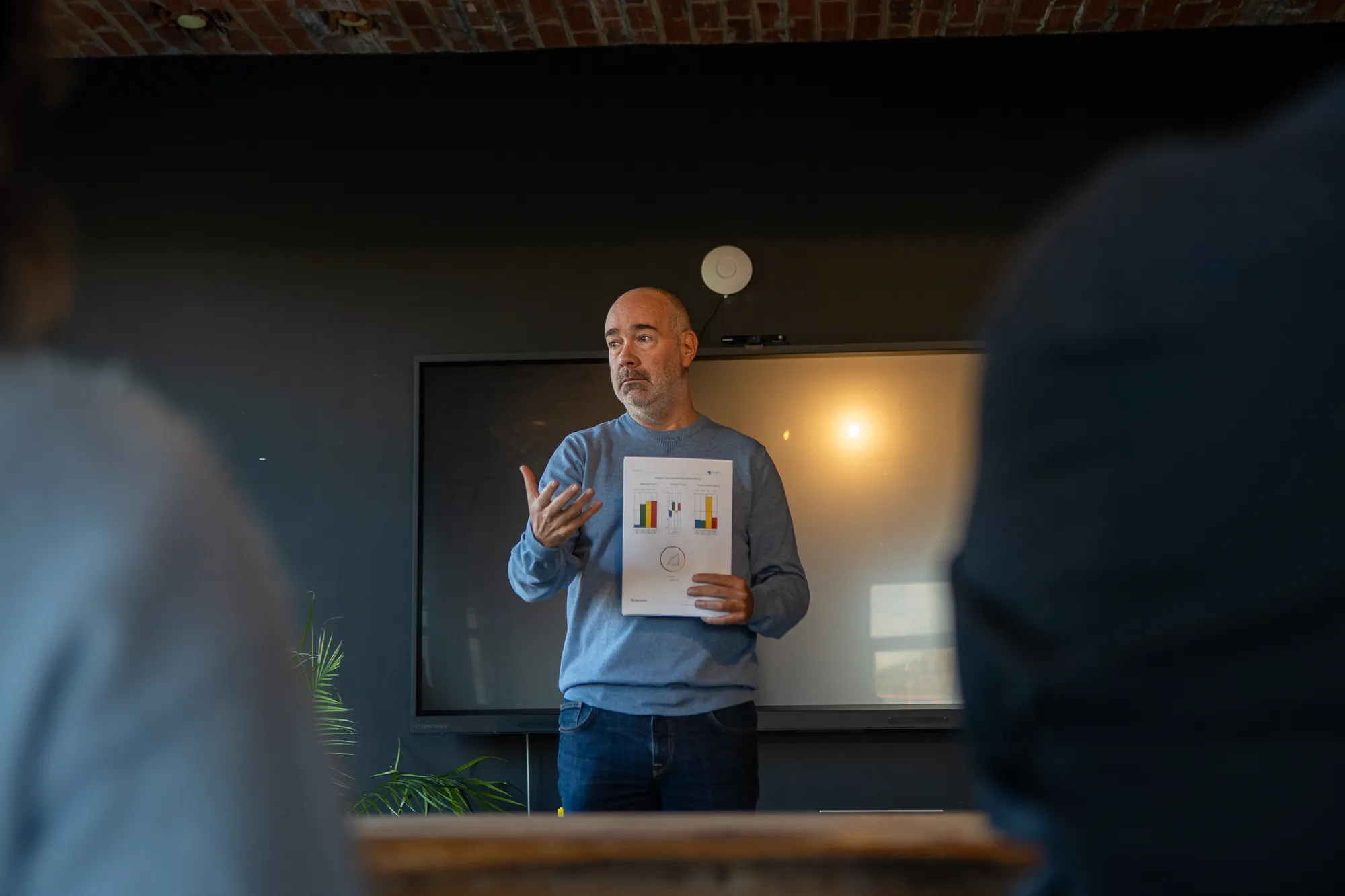
Another first wants to know what the team thinks, and a fourth already has three new ideas. According to the DISC model, you’re simply each behaving in a different style. In this blog you’ll read what the four DISC styles mean, how a DISC test works, what a free test gives you and what you can do with it in a team.
In short: The DISC model describes behaviour with four styles: Dominance (direct and results-driven), Influence (enthusiastic and sociable), Steadiness (patient and loyal) and Conscientiousness (precise and analytical). It goes back to the work of psychologist William Moulton Marston in the 1920s. Everyone has their own mix of the four styles. DISC is simple and quick to apply, for example in sales and leadership, and closely resembles the four Insights colours.
Where the DISC model comes from
In 1928 the American psychologist William Moulton Marston described how ordinary people show their emotions in their behaviour. He looked at two questions. Do you experience your environment as friendly or as hostile? And do you feel stronger than your environment or rather weaker? Those combinations produced four behavioural styles. Marston didn’t create a test himself. Only later did others build a questionnaire around it, and today there are dozens of versions.
To simplify, you can also place the four styles like this: are you rather fast and outspoken, or calm and reserved? And do you focus more on the task or on the people? Those two axes produce the four letters.
| Style | Pace and focus | Typical behaviour | Motivated by | Pitfall | Insights colour |
|---|---|---|---|---|---|
| D – Dominance | Fast, task-focused | Direct, decides quickly, takes charge | Challenge, results, control | Impatient, listens too little | Fiery Red |
| I – Influence | Fast, people-focused | Enthusiastic, persuasive, sociable | Recognition, contact, freedom | Little eye for detail | Sunshine Yellow |
| S – Steadiness | Calm, people-focused | Patient, loyal, helpful | Certainty, harmony, appreciation | Avoids change and conflict | Earth Green |
| C – Conscientiousness | Calm, task-focused | Precise, analytical, critical | Quality, clarity, rules | Perfectionism, indecisive | Cool Blue |
Dominance: the one who sets the direction
People with a strong D style want results. They make decisions, say what they think and love a challenge. In a crisis they’re worth their weight in gold. Under pressure they can come across as blunt and forget that others need time. Working with someone with a lot of D? Get straight to the point, start with the conclusion and leave room for their own decision.
Influence: the one who gets people on board
A strong I style brings energy. These colleagues persuade easily, make contact quickly and see opportunities everywhere. They like working with others and love recognition. Their pitfall: they start a lot and don’t finish everything, and details feel like a brake. You work best with someone with a lot of I by giving room for ideas and then agreeing together on what will actually happen.
Steadiness: the one who holds the team together
The S style stands for calm, loyalty and reliability. These colleagues listen well, like to help and make sure everyone is on board. They like predictability and need time to get used to change. Their pitfall is that they stay quiet too long when something isn’t right. So ask someone with a lot of S explicitly for their opinion, preferably not in a large group, and explain why something is changing.
Conscientiousness: the one who wants to get it right
The C style wants things to be correct. These colleagues analyse, check and ask critical questions. They deliver quality and prevent mistakes. Under pressure they keep analysing and their criticism can come across as distant. Working with someone with a lot of C? Provide information in advance, back up your proposal with facts and give them time to think.
How does a DISC test work?
A DISC test is a questionnaire in which you repeatedly choose which statements fit you best and least. Depending on the version, it takes ten to twenty minutes. The result is a DISC profile: a chart showing how strongly each style is present in you, with a description of your behaviour, your strengths and your pitfalls.
Many versions show two charts: your natural style and the style you adopt at work. The difference between the two says something about how much you adapt, and how much energy that costs. You’ll find the same idea in the Insights Discovery profile. How that works is explained in The Insights Discovery test.
What is a free DISC test worth?
If you google “free DISC test”, you’ll immediately find a row of websites with a short free test. They give a first impression of your style, and are a fun way to get to know the model. Still, there are three caveats. Quality varies widely: some tests are thoroughly researched, others are a handful of questions without validation. The results can’t be compared with each other, because every provider has its own version. And nobody discusses the result with you, while that’s exactly where the value lies.
If you want to use DISC or another model in a team, choose one version for everyone and plan a moment to discuss the results together. Otherwise each colleague compares their own test, and after a week the insight disappears into a drawer.
What DISC is good at, and what it isn’t
- Strong: easy to understand, quick to apply, useful in sales, customer contact and leadership.
- Strong: four styles are easy to remember, even after the workshop.
- Less strong: there are many different versions, of varying quality.
- Less strong: DISC mainly looks at visible behaviour, less at what lies beneath it, such as how someone processes information.
- Note: DISC is designed for development, not for deciding who gets a job.
In sales, DISC is often used to read customers: a customer with a lot of D wants a short pitch focused on results, a customer with a lot of C wants figures and a detailed quote. That works, and it’s exactly the same idea you apply with the Insights colours.
DISC and the Insights colours: same idea, different depth
If you know DISC, you’ll recognise the Insights colours straight away. Dominance roughly corresponds to Fiery Red, influence to Sunshine Yellow, steadiness to Earth Green and conscientiousness to Cool Blue. Both models use four styles that everyone has in their own mix. The difference lies in origin and depth. Insights Discovery builds on the psychology of Carl Jung and therefore also looks at how you take in information and decide. It distinguishes eight types and 72 positions, and the profile is more extensive.
For a team that has an advantage: colours stick more easily than letters, and a shared language is exactly what you want to keep after a workshop. What each colour means is explained in The Insights colours explained. You’ll find a detailed comparison of DISC, MBTI and Insights in Insights Discovery, DISC or MBTI.
DISC or Insights for your team?
If your organisation has worked well with DISC for years, there’s no reason to switch. A shared language everyone knows is worth more than the perfect model. If you’re starting fresh, many teams choose Insights Discovery: the colours are accessible, the profile goes deeper and the model emphasises what makes each style valuable. JDI supports teams at SMEs, family businesses and scale-ups with a personal profile for each team member, a workshop and concrete agreements about how they work together. At Buildwise more than 300 employees went through the same workshop day. Read more about our approach on the Insights Discovery page.
Frequently asked questions
What does DISC stand for?
DISC stands for the four behavioural styles in the model: Dominance, Influence, Steadiness and Conscientiousness. In some versions the C is also called Compliance or Correctness. Each letter describes a way in which people respond to challenges, to others, to pace and to rules.
Which DISC style am I?
You’ll see that after a DISC questionnaire, but most people don’t have just one style. They have a combination, with one or two styles that are more strongly present. A first guess: if you’re fast and task-focused, you’re more likely D. Fast and people-focused: I. Calm and people-focused: S. Calm and task-focused: C.
Is there a free DISC test?
Yes, online you’ll find various free DISC tests. They give a first impression of your style, but vary widely in quality, and the results aren’t always comparable. If you want to use DISC in a team, choose one version for everyone and discuss the results together.
Is DISC scientifically sound?
Partly. Marston’s theory is old and simple, and the quality depends heavily on which version you use. Good versions have been tested for reliability. DISC describes behavioural preferences, not a fixed personality, and is therefore mainly useful as a conversation tool, not as a diagnosis.
What is the difference between DISC and the Insights colours?
They’re very similar: dominance roughly corresponds to red, influence to yellow, steadiness to green and conscientiousness to blue. The difference lies in origin and depth. Insights Discovery builds on Jung, distinguishes 72 positions and also shows how you adapt to your work environment. DISC is simpler and quicker to apply.
Discover your team’s colours.
Want to work on behavioural styles with your team, using a model that sticks after the workshop? Tell us briefly about your team and what you want to achieve, and we’ll propose a tailored programme. Email hallo@jdi.be or call 016 88 37 55. Discover your team’s colours
More insights

What does a DISC test measure, what doesn’t it, and what do you gain with your team? Five steps, a comparison with Insights and MBTI and a short exercise.

What is peer supervision, how does it differ from supervision and coaching, and how do you run a session? Six steps, an example and eight good questions.

A summary of Vlerick’s Six Batteries of Change: the six batteries, how to scan them with your management team and how it differs from Kotter and ADKAR.
Want to take this on in your business?
You don’t have to have your question sorted yet. Working that out is exactly where we start.